
Reviewed · WALKING TOURS IN UBUD
Myth of Pejeng Walking Tour
Pejeng’s oldest stories are hiding in plain sight. This two-hour walk leaves busy Ubud behind for four sacred and archaeological sites, linking Balinese myth, temple ritual, and pre-Hindu remains in a small group of no more than eight people. I like the rare access to the Pejeng moon drum and the chance to see a quieter side of Bali, away from Ubud’s main streets.
I also like that the price includes temple donations, a sarong and sash, Balinese coffee, tea, and a snack. Guides such as Joe, Bagus, and Win have been praised for making time for complex questions and explaining customs clearly. The main consideration is the walking surface: uneven stairs, steep sections, and patchy sidewalks mean this is not a smooth, easy stroll for everyone.
- See the Moon of Pejeng: Enter Pura Penataran Sasih and view Southeast Asia’s largest bronze kettle drum.
- Walk through quieter Pejeng: The route connects four important sites rather than keeping you in central Ubud.
- Meet Bali before Hinduism: The Arca Building Archaeological Museum displays large ancient sarcophagi.
- Learn through local stories: The tour connects temple carvings, myths, tantra, ceremonies, and village customs.
- Keep the group small: The maximum is eight people, which gives you a better chance to ask questions.
- Bring practical gear: Wear comfortable walking shoes, carry a reusable bottle, and allow extra time in case the tour runs closer to two and a half hours.
In This Review
- Why Pejeng Makes a Better History Walk Than Central Ubud
- Starting at 8:30 at Indomaret Pejeng
- Pura Penataran Sasih and the Moon of Pejeng
- Pura Pusering Jagat at Bali’s Spiritual Center
- Kebo Edan and the Bhairawa Statue
- The Arca Building and Bali Before Hinduism
- A Guide Makes the Difference
- Timing, Weather, and Physical Effort
- What the $21.40 Price Really Covers
- Who Should Book the Myth of Pejeng Walk
- Should You Book It?
- FAQ
- Where does the Myth of Pejeng Walking Tour start?
- Where does the tour end?
- What time does the walking tour begin?
- Is hotel pickup or drop-off included?
- What should I wear to the temples?
- How large is the group?
- Can I cancel for a full refund?
Why Pejeng Makes a Better History Walk Than Central Ubud
Ubud is famous for galleries, cafés, rice fields, and dance performances. Pejeng offers a different kind of cultural visit. Here, the focus is on temples and ancient objects that still connect with local religious life.
The Myth of Pejeng Walking Tour costs $21.40 per person. That is a fair price for a small-group experience that includes a local English-speaking guide, temple donations worth Rp 60,000, temple clothing, refreshments, and admission to all four stops. You are paying less for transport or entertainment and more for interpretation, access, and context.
That distinction matters. A temple can look impressive for five minutes, but the meaning of a carved figure or ritual object is not always obvious. A good guide gives you the story behind what you see and explains how the site fits into Balinese belief.
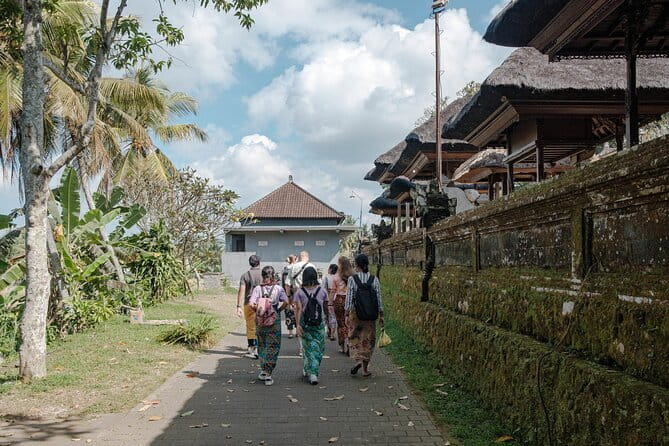
The route also takes you into Pejeng, a quieter area than central Ubud. You will walk between stops rather than being driven from one attraction to the next. That makes the experience feel more connected to the village, though it also means you should be ready for ordinary sidewalks and local roads.
Starting at 8:30 at Indomaret Pejeng
The meeting point is Indomaret Pejeng on Jalan Raya Dr. Ir. Sukarno in Bedulu, Gianyar. The tour starts at 8:30 am and ends at the Arca Building Archaeological Museum.
There is no pickup or drop-off from your accommodation, so you need to arrange your own way to the starting point and from the museum afterward. The meeting point is near public transportation, but the information provided does not specify a shuttle or private transfer.
An early start is useful in Bali. You begin before the strongest heat of the day, and one practical suggestion is to arrive early enough to visit the local market before the walk. That extra stop is not part of the tour, but it can help you get your bearings in Pejeng before meeting the guide.
The ticket is mobile, so you can keep confirmation on your phone. Bring water in a reusable bottle. Ubud Story Walks encourages refills to reduce plastic in Bali’s rivers, and that is a small but sensible touch.
More Walking Tours in Ubud
- Sidemen Trekking: A Walk from a Different Perspective
★ 5.0 · 94 reviews - Ubud Guided Walking Tour
★ 5.0 · 79 reviews - Ubud Countryside Tour: Campuhan Ridge Walk and Rice Terrace
★ 5.0 · 72 reviews
Pura Penataran Sasih and the Moon of Pejeng
The first stop is Pura Penataran Sasih, one of Bali’s oldest temples. You will put on a sarong and sash before entering. These are provided, so you do not need to pack your own, though you may bring one if you prefer.
The main prize here is the enormous bronze kettle drum known as the Moon of Pejeng. The drum is described as the largest bronze kettle drum in Southeast Asia, and the group receives special access to see it. This is the kind of object that rewards explanation. Its scale is striking, but the legends tied to it are what make the stop memorable.
The tour explores local myths surrounding the drum and the role of sacred objects in Balinese culture. You should expect storytelling rather than a long formal lecture. Guides have also discussed temple customs and sacred artifacts in detail, so this is a good point to ask questions.
You will spend about 20 minutes here. That is enough for a focused visit, but not enough for a slow, unhurried examination of every corner. If you want extended time at each temple, this tour may feel brisk.
Temple etiquette is important. Men and women must wear a sarong that covers the legs below the knee, along with a sash. Since these are active religious places, modest clothing and respectful behavior are part of the experience, not just a dress-code formality.
Pura Pusering Jagat at Bali’s Spiritual Center

The walk continues to Pura Pusering Jagat, one of Bali’s six main Kahyangan directional temples. It is believed to sit at the center of the island, giving the site a strong symbolic role in Balinese religious thought.
This stop is another 20-minute visit. The focus is on the temple complex and its intricate carvings, along with the beliefs that connect the site to Bali’s sacred geography. You will likely get more from this section if you listen for how the guide links place, direction, ritual, and myth.
This is also where the walking format pays off. Moving from one temple to another gives the guide a chance to explain how the sites relate to one another. You are not simply collecting four disconnected photo stops.
At the same time, the route is not designed as a strenuous hike. One account describes roughly 4,000 or more steps with very few stairs. Still, the operator warns about uneven temple steps, steep gradients, and rough sidewalks. Your total effort will depend on the exact route and pace, so comfortable shoes are sensible.
Ceremonies can change the feel of a temple. If a local ceremony is taking place, you might see the complex filled with people and activity. That is a fortunate bonus, not something the tour promises on every date. The guide can help you understand what you are seeing while reminding you to remain respectful.
Kebo Edan and the Bhairawa Statue

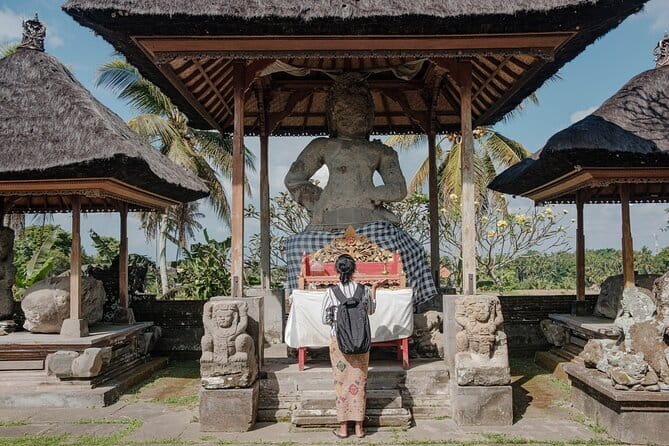
Kebo Edan means Temple of the Crazy Buffalo. It is a small temple with a large subject: a striking 13th-century Bhairawa statue recovered from nearby rice fields.
The statue raises questions about Bali’s religious past. The guide explains theories about its origins and its possible connection to tantra. This is one of the more unusual stops because the object does not offer a simple, tidy story. You get competing ideas and a chance to think about how religious traditions changed over time.
The visit lasts about 20 minutes. That keeps the pace moving, but it also means you should pay close attention when the guide explains the statue. Details about symbols and posture can be easy to miss if you are focused only on photographs.
This stop may appeal most to you if you enjoy archaeology and religious art. If you prefer grand temple courtyards or long scenic pauses, Kebo Edan may feel more specialized. Its value comes from the story and the statue, not from size.
The walk between sites remains part of the lesson. You are passing through Pejeng rather than riding in an air-conditioned vehicle, so expect a more ordinary village setting. That can mean traffic, broken pavement, and heat. It also gives you a better sense of how sacred places fit into daily life.
A completely different kind of day out in Ubud:
- All-Inclusive Ubud Private Tour
★ 5.0 · 14,344 reviews - Best of Ubud Full-Day Tour with Jungle Swing
★ 5.0 · 8,571 reviews - Ubud: Monkey Forest, Jungle Swing, Rice Terrace, and Water Temple
★ 5.0 · 7,160 reviews - Best of Ubud 1-Day Private Tour
★ 5.0 · 4,451 reviews
The Arca Building and Bali Before Hinduism

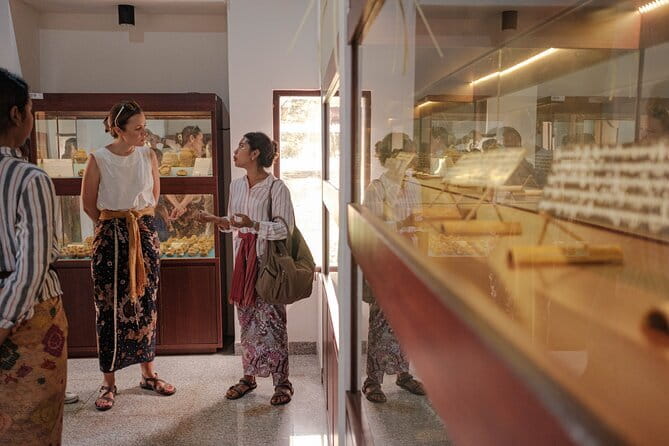
The final stop is the Arca Building Archaeological Museum, where the tour steps back to pre-Hindu Bali. You will see giant sarcophagi arranged in an open courtyard and learn about ancient Balinese life and burial customs.
This 30-minute visit is the longest stop, which makes sense. The sarcophagi need context, and this is where the tour’s themes come together. You have seen living temples, sacred objects, mythic figures, and carved symbols. Now you encounter physical remains from an earlier period.
The museum is especially useful for anyone who wants to understand that Bali’s culture did not begin with the arrival of Hindu traditions. The ancient objects point to older practices and beliefs, giving you a broader view of the island’s past.
Do not expect a large museum complex with a long indoor exhibition route. The tour describes an open courtyard with giant sarcophagi. That simplicity is part of the appeal, but it may not satisfy anyone looking for extensive museum displays.
The end point is the museum, not your hotel. Plan your next move before the tour begins. You might arrange transport onward, or check local connections near the area. The tour company does not provide a return transfer.
A Guide Makes the Difference

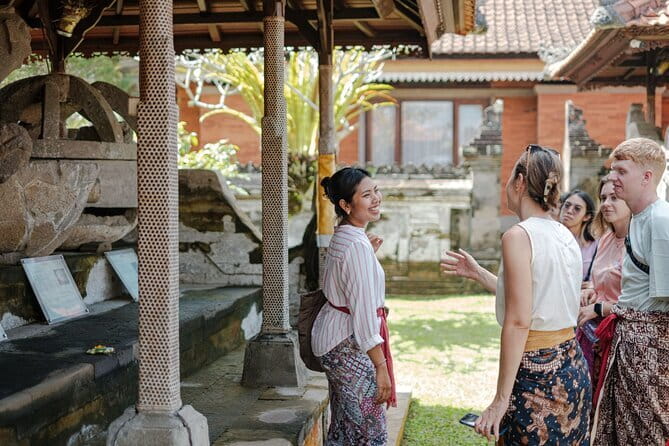
The strongest feature of this walk is the guiding. Joe has been praised for explaining Balinese culture, religion, temple artifacts, the Moon of Pejeng, tantra, and ancient sarcophagi. He also guided an 83-year-old participant and her companion, showing that the pace can work for older people who are comfortable walking.
Bagus has guided the route with Joe, and both have been described as willing to answer questions along the way. Win has also been praised for allowing time for complex questions and bringing useful items such as proper temple attire, sunblock, and insect repellent.
Those details matter because this is not a self-guided sightseeing circuit. The buildings and statues are the setting, but the guide provides the thread connecting them. You should feel free to ask about ceremonies, symbols, myths, and customs rather than simply following along quietly.
The operator also offers an Indonesian guide. The standard experience includes a local English-speaking guide, so confirm your preferred language when booking if that matters to you.
Timing, Weather, and Physical Effort
The stated duration is about two hours, but you should keep two and a half hours available. A reported outing lasted that long, and the walk includes four stops plus time on the road between them.
The tour operates in rain or shine. Severe weather, such as an intense downpour, may affect the start time, and the company says it will call before the tour if conditions are serious. Bali weather can change quickly, so a light rain layer is practical.
You should be able to climb temple steps and walk through an urban village setting for up to two hours. The route is not described as wheelchair accessible, and uneven stairs, steep sections, and patchy sidewalks can be difficult for anyone with limited mobility.
Service animals are allowed, and most people can participate. That broad participation note should not replace your own judgment. If you have trouble with steps or uneven ground, contact the operator before booking.
What the $21.40 Price Really Covers
At $21.40, the tour is good value if you want an informed cultural walk rather than transport between famous attractions. The inclusions remove several small expenses: temple donations, admission, sarong and sash rental, and a Balinese coffee, tea, and snack.
The small group limit of eight is another reason the price works. You are more likely to hear the guide clearly and ask follow-up questions than on a large coach excursion. The experience is still budget-friendly, but it does not feel stripped down.
There are limits. Food and drinks bought outside the included refreshment are your responsibility. Transportation to the start and away from the museum is also separate. If you are staying far from Pejeng, the extra transport cost may affect the overall value.
I would choose this tour for cultural context, not for maximum sightseeing volume. Four stops in roughly two to two and a half hours gives you a focused introduction, not an exhaustive tour of Pejeng.
Who Should Book the Myth of Pejeng Walk
I would recommend this experience if you want to:
- See important temples with explanations instead of only taking photos
- Visit a quieter area outside central Ubud
- Learn about Balinese religious customs and temple etiquette
- Explore pre-Hindu artifacts and ancient sarcophagi
- Ask detailed questions in a small group
- Walk at a moderate pace over uneven village streets
It is less suitable if you need hotel pickup, dislike walking in heat, or want a polished route with smooth pavement throughout. It may also disappoint you if your main goal is scenery, shopping, or a long temple photography session.
Wear modest clothing, though the sarong and sash are supplied. Bring a reusable water bottle, sun protection, and insect repellent if you normally use them. Arrive prepared for weather changes and allow more than the advertised two hours.
Should You Book It?
Book the Myth of Pejeng Walking Tour if you want Bali explained through its sacred sites, legends, and ancient objects. The Moon of Pejeng, the unusual Bhairawa statue, and the pre-Hindu sarcophagi give the route real substance, while the small group keeps it personal.
I would skip it only if uneven walking, independent transport, or a longer village visit is a problem. For the price, the included donations, clothing, refreshments, and guide make this a strong choice for anyone who wants a thoughtful cultural morning near Ubud.
FAQ
Where does the Myth of Pejeng Walking Tour start?
It starts at Indomaret Pejeng, Jalan Raya Dr. Ir. Sukarno No. 552, Bedulu, Blahbatuh, Gianyar, Bali 80552, Indonesia.
Where does the tour end?
The tour ends at the Arca Building Archaeological Museum in Bedulu, Blahbatuh, Gianyar Regency, Bali.
What time does the walking tour begin?
The start time is 8:30 am.
Is hotel pickup or drop-off included?
No. You must arrange your own transportation to the starting point and from the museum after the tour.
What should I wear to the temples?
Men and women must wear a sarong covering the legs below the knee and a sash. The tour provides both, though you may bring your own sarong.
How large is the group?
The tour has a maximum of eight participants.
Can I cancel for a full refund?
Yes. You can cancel at least 24 hours before the local start time for a full refund. Cancellations or changes made less than 24 hours before the start are not refunded or accepted.
Just added around Ubud
- Melangit White Water River Rafting★ 5.0 · 4 reviews
- UNESCO Sites Cultural Walking Tour in Bali★ 5.0 · 4 reviews
- Magical Village Tour & Private Dinner with Fireflies in Bali★ 5.0 · 4 reviews
- authentic Balinese organic cooking class in Ubud★ 5.0 · 4 reviews
- Balinese Cooking Experience★ 4.0 · 4 reviews
- 1 hour bali horse riding & Swim at the beach★ 3.5 · 4 reviews
- Ubud Tour : Monkey forest, Rice terrace, Water temple, Waterfall & Jungle Swing★ 5.0 · 4 reviews
- Bali Ayung River White Water Rafting with Transport★ 5.0 · 4 reviews
Walking Tours in Ubud, compared.

Sidemen Trekking: A Walk from a Different Perspective
Read our review →

Ubud Countryside Tour: Campuhan Ridge Walk and Rice Terrace
Read our review →

Browse the lists this tour appears in